
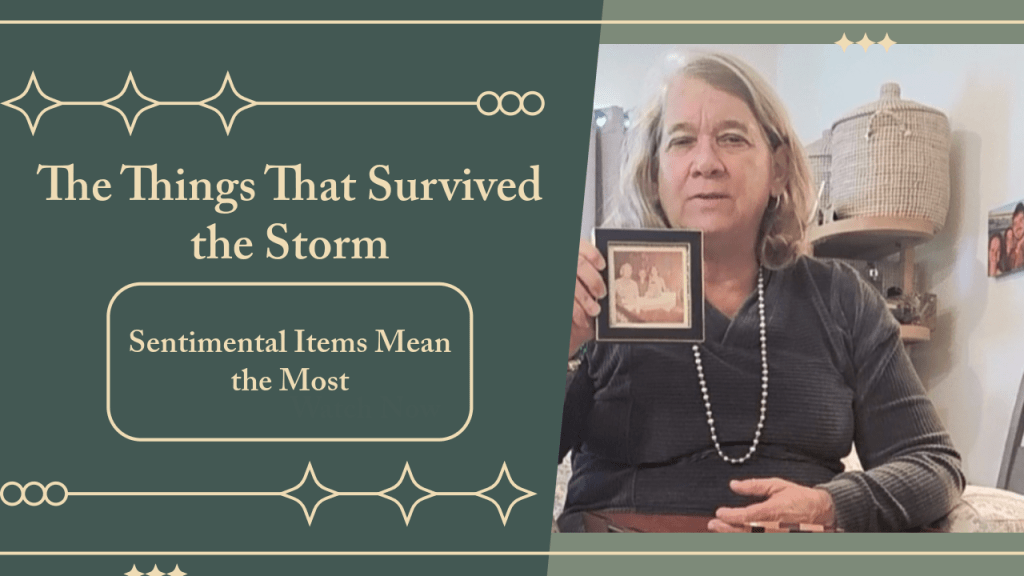
Seven and a half years ago, I lost everything in a hurricane—
or at least, it felt that way.
When the storm was approaching, one of those brutal systems that batter the Gulf Coast the way Hurricane Harvey once did, I packed what I could into my car. A suitcase of clothes. My jewelry box, because it held the things that mattered most. A few of my son’s belongings while he was away at college. My dog. A handful of odds and ends.
Whatever fit in the car went with me. The rest stayed behind.
I lived in a small duplex and offered to take my neighbors with me. They chose to stay. I still can’t quite believe it. I would have unloaded everything except my dog to make room for them, because lives matter more than things. Always.
When I came back, my house was destroyed. It was no longer a home.
What made that season even harder was that I wasn’t only grieving the loss of my house.
I was grieving my sister.
My oldest sister had just passed away after a three-and-a-half-year battle with ovarian cancer. She died the month before the hurricane. I was still deep in the fog of loss, still learning how to live in a world without her.
And then the storm came.
The hurricane made landfall on her birthday.
There is something surreal about grieving someone you love and then standing in the wreckage of your home on the day that should have been filled with phone calls, cake, and celebration. Instead, there were waterlines on the walls and furniture piled in the street.
I was already carrying heartbreak. The hurricane simply added another layer.
Losing belongings is painful—it feels invasive and overwhelming. But losing a person, especially someone who shaped your life the way a sister does, is a different kind of devastation. The storm took my things. Cancer had already taken someone I could never replace.
And yet, even in that unbearable season, I’m grateful. During her hardest years, I showed up. I visited. I sat with her. I was present. The hurricane could wash away photographs and furniture, but it couldn’t take the time I spent loving her.
That’s what remained.
Four feet of water filled my pier-and-beam house. Everything floated to the center of the rooms. The refrigerator tipped over. Sand and muck coated every surface. It took a week to carry everything I owned out to the curb—a lifetime reduced to a soggy pile waiting to be hauled away.
I salvaged a few pieces of glassware and washed them at my parents’ house again and again. I wore the same few outfits for three months while I slowly replaced the basics. Eventually, I found an apartment. I bought a sofa. A bed. Some generic art—just something with color so the walls didn’t feel so empty.
It takes time to rebuild a home.
It takes even longer to make it feel like yours again.
Over the past seven and a half years, I’ve slowly filled my space with things that reflect who I am—not placeholders, but pieces that carry meaning. Because in the end, it’s not the sofa or the bed that matters.
It’s the stories.
Today, I have a few things that mean the world to me, even if they mean nothing to anyone else.
I have a lamp that belonged to my stepmother’s mother. She became one of my moms when I was seven. After my dad and stepmother passed, the lamp came to me. I replaced the shade, but the base is still hers. When I turn it on, it feels like continuity.
I have a small box that belonged to my grandfather. It used to sit beside his chair. Now it sits in my home, holding a ring one day, a piece of candy the next. Ordinary use. Extraordinary meaning.
When my children were young, I kept boxes filled with their artwork and little treasures. I lost all of that. But tucked inside my jewelry box—saved only because it fit in my car—were two small things:
a tiny bracelet my son made when he was three or four, and a pendant with my daughter’s photo when she was two.
I have a colorful glass necklace my sister gave me—vibrant and beautiful, just like she was. When I hold it, I feel close to her.
I have my mother’s compact. The image on the front has faded almost beyond recognition. To anyone else, it’s nothing special. To me, it’s priceless.
I have my dad’s yo-yo, his name engraved on the side. I can still see him standing in the living room, smiling as he showed us tricks.
And I have a bowl that reminds me of my brother. He was two years older than me and passed away far too young, in his forties. I had once given the bowl to him, and somehow, over time, it found its way back to me. The matching one I owned was destroyed in the storm, but this one remains. Every time I see it, I think of him—and it feels like a small piece of him is still here.
These things are not valuable in the traditional sense. They wouldn’t fetch much at a garage sale. They don’t impress guests.
But they anchor me.
Recently, someone I know lost everything in a fire. Watching them walk through that devastation brought it all back—the shock, the grief, the disbelief. You cannot replace your child’s artwork. You cannot recreate handwritten notes. You cannot rebuild certain pieces of your history.
But here is what I learned:
At the end of the day, they are still just things.
The people.
The memories.
The time you showed up.
The love you gave.
That’s what survives.
If you’re walking through loss right now, I know how devastating it feels. It feels endless. But slowly, piece by piece, you will rebuild—not the same life, but a new one.
So go live your life.
Be present.
Be grateful.
Hold your loved ones close.
And remember: the things that matter most are the ones no storm can take away.

 Peppermint Paper