
For many, the idea of a 55+ senior community sounds like a dream: built-in social circles, simplified maintenance, and a quiet environment. I gave it a genuine try for four years, living in a ten-story high-rise. But as I’ve reflected in my recent writings, “home” is about more than just a floor plan—it’s about the energy surrounding you.
By the end of my fourth year, I realized that while these communities work for some, they weren’t the right fit for me. Here is why I decided to move back into a multi-generational neighborhood.
The Power of Age Diversity
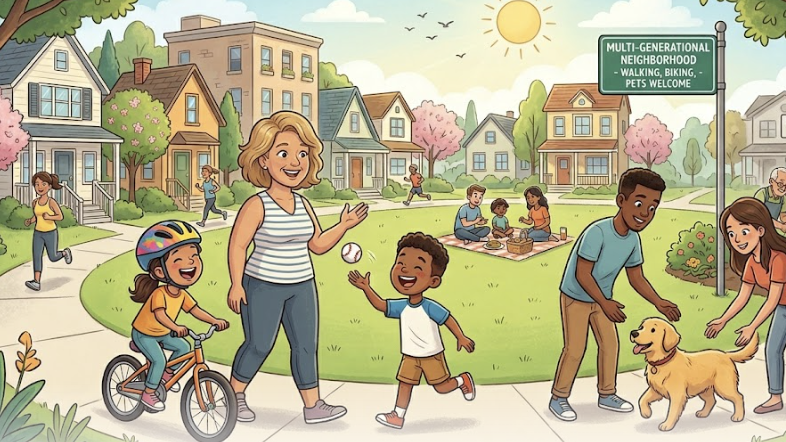
One of the most striking things about senior living is the lack of age diversity. While it was nice when grandchildren visited, the day-to-day was overwhelmingly uniform. I’ve come to realize that I thrive on the “in-between” moments of a mixed-age neighborhood.
I love being out and about and chatting with children, meeting neighbors of all ages, and even stopping to pet their dogs. There is a specific vitality that comes from living near people who are in different stages of life. It keeps the community feeling “alive” rather than static. For me, seeing the full spectrum of life—from toddlers to young professionals—is a much more natural and fulfilling way to live.
The Burden of Over-Regulation
We often think of HOAs as a way to protect property values, but in senior communities, they can sometimes feel like a tool for excessive control. My community was built in the 1960s, and while it had history, it also had an abundance of rules.
The Sunday Scolding: I’ll never forget trying to move on a Sunday. I was actually scolded by a neighbor who informed me it was strictly forbidden. Because of that rule, I had to move the following day in the pouring rain.
I suspect that many residents who were high-achieving professionals in their careers carry that need for “order” into their retirement. They enjoy the rules and regulations, but for me, that level of oversight felt stifling. At this stage in my life, I value my autonomy more than ever.
The Hidden Costs: Financial and Emotional
There are practical hurdles to living in these older high-rise buildings. Between skyrocketing insurance costs and the constant maintenance of aging infrastructure, the fees can become a significant financial drain. But beyond the wallet, there is an emotional cost I wasn’t prepared for.
In four years, I lost eight neighbors. One was my next-door neighbor, a wonderful woman who had been a paraplegic since age nineteen. We were very close, and losing her hit me hard. She was an inspiration to me every day and a joy to be around. A friend of mine jokingly called the building “Death Tower,” and while that’s a bit dark, it highlights a reality: when everyone in your circle is in a certain age bracket, loss becomes a frequent, heavy visitor.
Looking Forward: Fitness, Health, and Choice
I’m in my early sixties, but I feel young. My goal now is to focus on my fitness, eat properly, and maintain the health I need to stay in a multi-generational environment. I’ve learned that I don’t want to be “sequestered” with only people my own age.
My advice if you’re considering the move?
- Rent first: Don’t buy immediately. See if the “vibe” matches your lifestyle.
- Check the Resale: Remember that when you sell, your market is restricted to a very specific age and fit, which can make moving out much harder than moving in.
Living in a senior community taught me exactly what I don’t want, which has made me appreciate my current home—and the sounds of kids playing outside—that much more.
YouTube Video: https://youtu.be/bsBW9hEWgkQ?si=Bpr65MFkf371HBUZ

 Peppermint Paper