
There is a specific kind of clarity that comes with living in a 740-square-foot sanctuary. When you downsize from a large family home to a smaller footprint, every object you own begins to tell a story—or it begins to take up space.
As many of you know, I began my 2026 No-Buy Year a little early, back on December 1st. My goal was simple but challenging: to move away from impulse purchases and toward a life of “underconsumption,” focusing on what I already have.
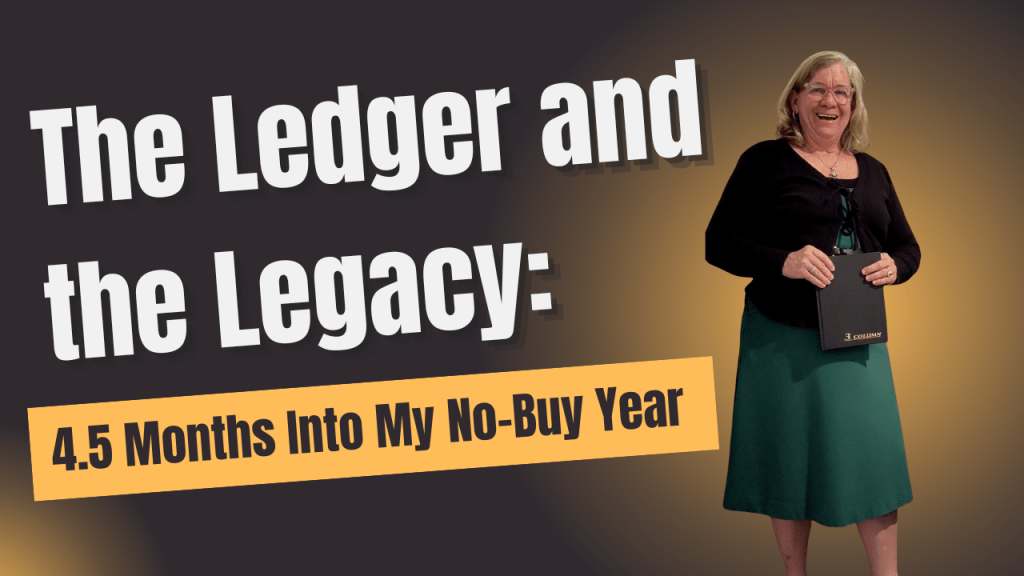
Today, I’m four and a half months in, and I wanted to share an update on the numbers, the emotions, and one very special piece of furniture that reminds me why I started this journey.
The Data: Reading Between the Lines
I’ve been tracking every non-essential purchase in my 3-column ledger. To date, I have exactly seven entries totaling $284.
There is something incredibly satisfying about the discipline of a physical ledger. It forces a pause. When I see a “want” in a store, I now wait 24 to 48 hours. Most of the time, the urge fades, and the ledger page remains clean.
But minimalism isn’t about deprivation; it’s about intentionality. This month, I spent $70 on organizational trays. While that might seem like a “buy” during a “no-buy” year, the reason behind it makes all the difference.
The Legacy: My Father’s Cabinet
The $70 went toward organizing a beautiful cabinet that recently found its way into my home. This piece belonged to my father. For close to sixty years, it sat on his workbench in the garage. It was a connection to his mother as well as holding his tape measures, nails, and drill bits.
My father worked with high expertise well into his 80s, and I’ve always held a deep respect for his work ethic. When he passed, I asked my siblings if I could have this cabinet. With the help of an old friend who builds beautiful furniture, it was refinished and restored.
It now sits perfectly on my nightstand. It’s no longer a garage fixture; it’s a legacy piece.
Repair Over Replacement
Another lesson this journey has taught me is the value of community and repair. Recently, a chair that belongs to my dining set broke. In years past, I might have browsed for a replacement. Instead, a neighbor—part of the wonderful, multi-generational community I’ve grown to love here—was able to fix it for me.
This “old-school” way of living—borrowing dishes, chatting during evening walks, and repairing what is broken—is the true heart of minimalism. It’s about people over products.
The 4.5 Month Takeaway
If you are considering your own No-Buy challenge or simply want to practice more intentional spending, here is my advice: Focus on the legacy.
Ask yourself:
- Does this item serve my current life in my current space?
- Can it be repaired or organized rather than replaced?
- Does it carry a story worth keeping?
I’m $284 into this year, and I’ve never felt wealthier. My home is small, my kitchen is filled with “workhorse” cast iron and stainless steel, and my heart is full of the memories that my father’s cabinet holds.
Keep moving, keep intentional, and remember: most of what we already have is more than what we need.
YouTube Video Link: https://youtube.com/shorts/qiCqG13vTS8


